
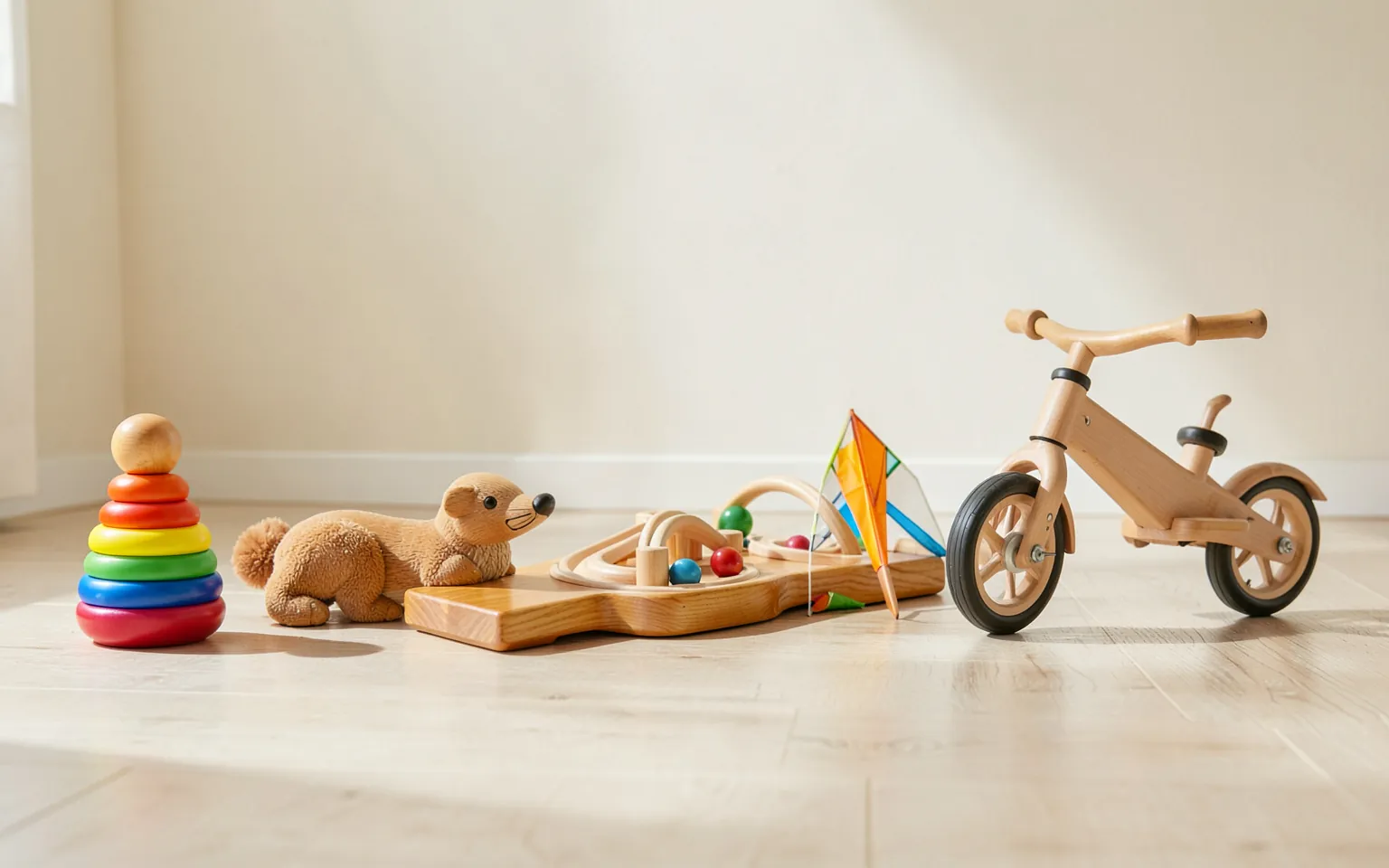
The age on a toy box is a safety minimum, not a recommendation. This guide explains what children are working on at each stage, what kind of toy helps, and which of our toys fit best.
Every child develops at their own pace, so treat the ages below as a range. A good rule: choose toys a child can succeed with today and still discover something new in six months.
0 to 12 months: senses and grasping
Babies learn through their mouth, hands and eyes. In the first year they go from reflex grasping to picking things up with thumb and finger, from lying to sitting and often to standing. Good toys are light enough to hold, too big to swallow, safe to chew and interesting to look at: contrast, texture and things that make a sound.
Our toys mostly start at 12 months, because that is when the toys we stock become playable in their own right. From around nine months, babies enjoy rocking the arches of the Arc of Seven with an adult nearby.
1 to 3 years: posting, stacking, walking
Toddlers want to put things in and take them out, stack things and knock them down, and move: walking, then climbing, then running. Language arrives in this period too, and the first pretend play (feeding a doll, “talking” on a block).
- Pebble Post (12m+): shape sorting, the classic posting game, with a roll-out front so it never ends in tears.
- Arc of Seven (12m+): nesting and stacking, and later bridges, tunnels and fences.
- Ollie the Otter (18m+): a pull-along for new walkers.
- Wobble Cove (18m+): rocking and balance, indoors.
- Pathfinder Balance Bike (from 2): learning balance before pedals.
3 to 5 years: pretend play and first building
This is the golden age of pretend play. Children act out what they see adults do (cooking, caring, shopping) and use play to work through what worried them, like a visit to the doctor. Building gets more ambitious and fine-motor control improves enough for small pieces. Most children can follow simple rules in a game by five.
- Little Larder (3+): a compact play kitchen.
- Dr. Pip’s Bag (3+): doctor play, helpful before appointments.
- Lantern Stage (3+): a puppet theatre for storytelling.
- Glint Tiles (3+): magnetic tiles, the easiest way to build in 3D.
- Fort Ferncastle (4+): a castle to colour in and then play inside.
- Clockwork Garden (4+): a gear wall for little engineers.
5 to 8 years: systems, rules and the outdoors
School-age children enjoy toys with a system to master: a marble run that has to be tuned, a game with a strategy, a kite that needs the right wind. They can follow multi-step instructions and use real tools with supervision. Co-operative games are especially good at this age, because losing together is much easier than losing alone.
- Cascade 120 (5+): a wooden marble run with a crank lift.
- Otter Rapids (5+): a co-operative family board game.
- Skylark Kite (5+): an easy delta kite.
- Bug Inn (5+): an insect hotel to build with a real screwdriver.
8 years and up: engineering and independence
Older children want real results: something that actually moves, flies or works. They can follow picture instructions alone and stick with a project for an hour or more.
- Sunbot 6-in-1 (8+): a solar robot kit with six builds.
- Many younger toys keep working at this age: Glint Tiles, Cascade 120, Clockwork Garden and Lantern Stage are still played with at ten.
Buying for more than one child
If you have children of different ages, look for toys that span the gap: the Wobble Cove Grande holds up to 150 kg, Glint Tiles work from three to ten, and Otter Rapids is co-operative, so a five-year-old and a nine-year-old play on the same team. Keep toys with small parts (marbles, magnets, small gears) for times when the youngest is asleep or in another room.